Details
ISBN/EAN: 978-9-02-771462-6
Einband: kartoniertes Buch
Weitere Details
Auflage:
1. Auflage 1982
1. Auflage 1982
Erschienen am:
31.07.1982
31.07.1982
Sprache:
English
English
Umfang:
672 S.
672 S.
Hersteller:
Springer Verlag GmbH
juergen.hartmann@springer.com
Tiergartenstr. 17
DE 69121 Heidelberg
Springer Verlag GmbH
juergen.hartmann@springer.com
Tiergartenstr. 17
DE 69121 Heidelberg
Weitere Details
arrow_forward_ios

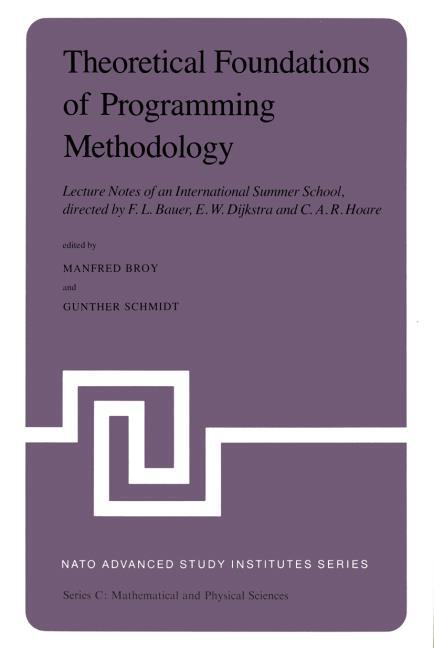
Theoretical Foundations of Programming Methodology
Lecture Notes of an International Summer School, directed by F.L.Bauer, E.W.Dijkstra and C.A.R.Hoare, Nato Science Series C: 91
53,49 €
inkl. MwSt.
Lieferbar innerhalb 1 - 2 Wochen
Beschreibung
Long ago~ the welfare of a sooiety used to depend heavily on the skill and dedioation of its oraftsmen - the miller~ the blaok smith~ the oobbler and the tailor. These oraftsmen aoquired their skill by a long and poorly paid apprentioeship to some master of their oraft. They learned by imitation and experienoe~ and by tri al and error. They did not read books or study soienoe~ they knew nothing of the theory of their subjeot~ the geometry of their ru dimentary drawings~ nor the mathematios underlying their primitive oaloulations. They oould not explain how or why they used their methods; yet they worked effeotively by themselves or in small teams to oomplete their tasks at a predioted oost~ to a fairly well predioted timesoale~ and usually to the satisfaotion of their olients. The programmer of today shares many of these attributes of a oraftsman. He learns his oraft by apprentioeship in an existing team of programmers - but his apprentiaeship is highZy paid and usually very short. He develops his skill by trial; but mostly by error. He does not study theory~ or even read books on Computer Soience. He knows nothing of the logical and mathematical founda tions of his profession; and he hates to explain or justifY~ or even to dooument what he has done.